


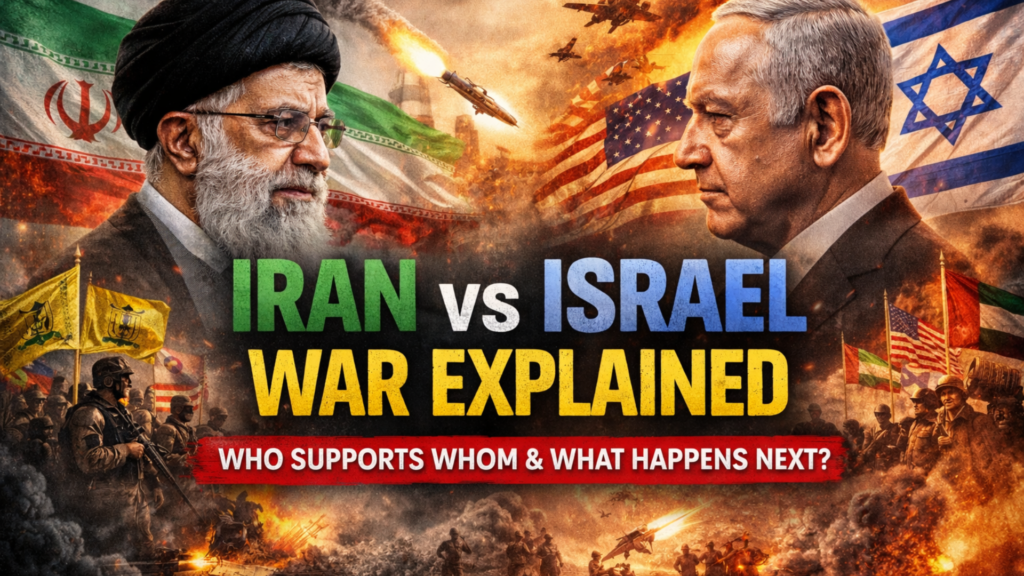
The Middle East is once again on edge.
What started as rising tension has now turned into open confrontation between Iran and Israel.
Airstrikes. Retaliation. Military alerts. Global concern.
But the real questions are simple:
Why are they fighting?
Who is supporting whom?
Could this become something bigger?
Let’s break it down clearly.
Why Are Iran and Israel Fighting? The Core Reasons
This conflict did not begin in 2026.
The hostility dates back to 1979, after Iran’s Islamic Revolution. Since then:
• Iran does not recognize Israel as a legitimate state
• Israel considers Iran its biggest long-term security threat
• Both accuse each other of destabilizing the Middle East
For years, the conflict remained indirect.
Israel targeted Iranian-linked positions in Syria.
Iran supported anti-Israel armed groups across the region.
Now, the confrontation is becoming more direct.
What Triggered the Latest Escalation?
Recent military strikes targeted Iranian-linked facilities.
Iran responded with strong retaliation signals, missile alerts, and military positioning.
Both countries claim they are acting in self-defense.
But global leaders fear escalation.
Which Countries Support Israel?
United States
The United States is Israel’s strongest ally.
It provides:
• Military assistance
• Financial support
• Diplomatic backing
Washington consistently supports Israel’s right to defend itself.
United Kingdom and Some European Nations
Several Western countries have expressed support for Israel’s security, while also urging restraint and civilian protection.
Certain Gulf Nations
Countries like UAE and Bahrain, which normalized relations with Israel in recent years, maintain diplomatic ties.
However, most Gulf countries are currently focused on preventing wider regional war.
Which Countries Support Iran?
Hezbollah
The Lebanon-based group backed by Iran.
Hamas
The Palestinian militant group that has historically received support from Tehran.
Russia
Russia has deepened ties with Iran in recent years. While calling for diplomacy publicly, it maintains strategic alignment with Tehran.
China
China has strong economic partnerships with Iran and pushes for regional stability while opposing Western military escalation.
Why This Conflict Matters Globally
This is not just a regional issue.
It affects the world.
Oil Prices
The Middle East controls major global oil routes.
Any instability can immediately increase crude oil prices.
Global Trade
Shipping lanes near the region are critical for international trade.
Escalation could disrupt supply chains.
Regional Security
If the conflict spreads, it could involve multiple countries and destabilize neighboring nations.
How Could This Affect India?
India imports a large portion of oil from the Middle East.
If tensions rise:
• Fuel prices may increase
• Inflation pressure may grow
• Indian citizens working in Gulf nations could face uncertainty
That’s why India is maintaining diplomatic balance while monitoring developments closely.
Is This Heading Toward a Bigger War?
Right now, global powers are trying to prevent full-scale escalation.
Diplomatic channels are active.
Military forces are on alert.
But no major nation wants a broader regional war.
The coming weeks are critical.
Can also read this article
The Bigger Geopolitical Picture
This is more than a military clash.
It is about:
• Regional power balance
• Ideological rivalry
• Security fears
• Global influence
The Iran–Israel conflict is one of the most complex rivalries in modern geopolitics.
And what happens next could shape international relations for years.